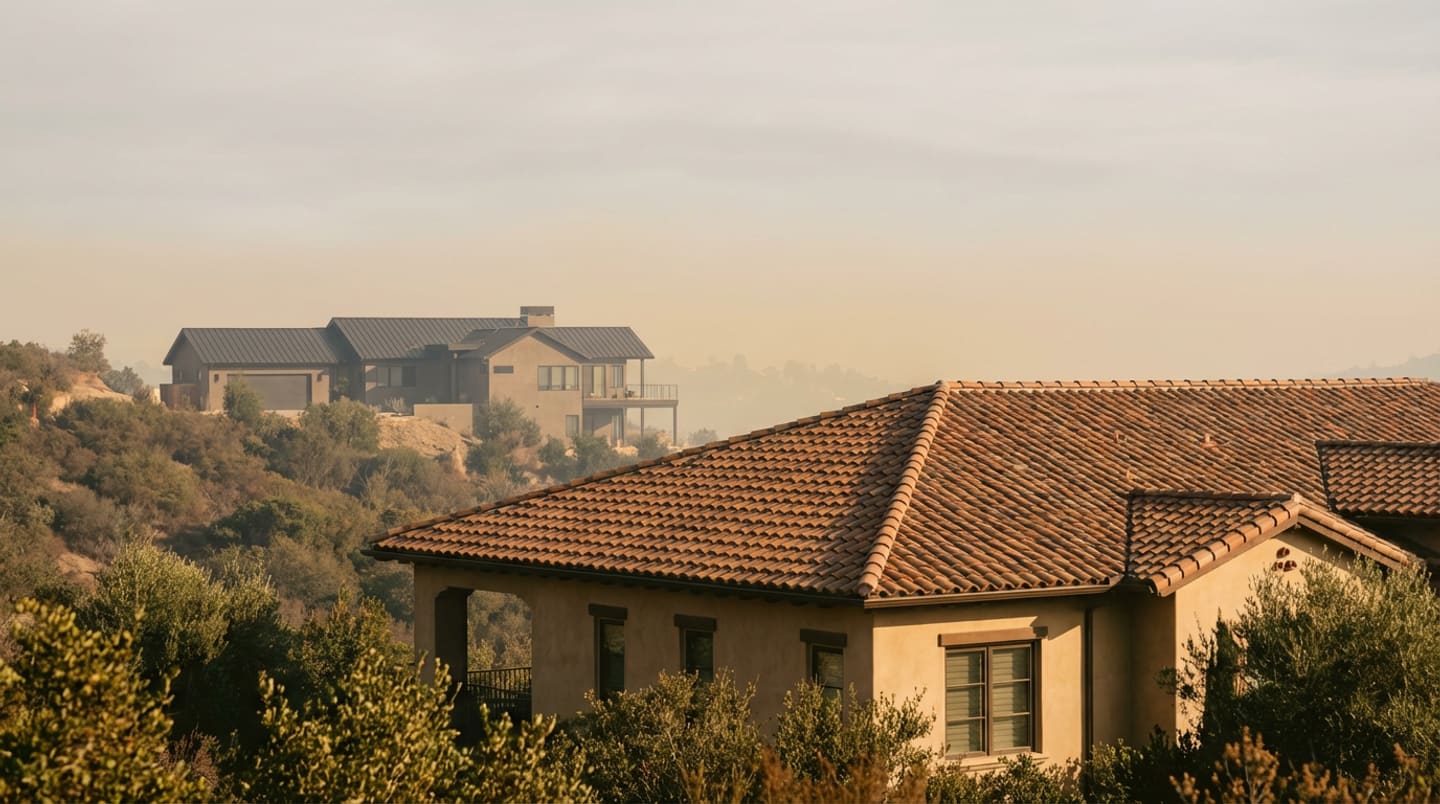
tile-vs-metal.png
We compared clay tile, concrete tile, and standing-seam metal head-to-head on LA-specific criteria: fire rating, lifespan, weight, HOA acceptance, cost. The short version: both are genuinely Class A, but the decision hinges on what your specific home and neighborhood demands.
Both clay tile and standing-seam metal carry a Class A fire rating when installed as an assembly with proper underlayment. Both will outlive asphalt shingle by decades. Both are accepted in every LA fire hazard severity zone. On paper they look interchangeable. In practice, they are anything but.
Clay tile: 75 to 100 years is realistic for the tile itself. The underlayment beneath will fail much sooner — usually at 30–40 years for premium synthetic, 20–25 years for felt-paper underlayment. A proper tile roof in LA gets "lifted and relaid" once in its life: tiles are carefully removed, underlayment replaced, tiles go back down. Cheaper than a full re-roof by a wide margin.
Standing-seam metal: 50+ years for the panels is conservative. We have inspected Southern California metal roofs over 60 years old with no failures. The fasteners and sealants degrade before the metal does, which is why a quality install matters so much.
Concrete tile: 50 years for the tile, similar underlayment cycle as clay. Heavier than clay; requires structural engineering review on older LA homes before install.
Class A is a rating on assembly, not just the top material. An asphalt shingle roof over OSB decking with standard felt can technically earn Class A — but will it actually resist 90 minutes of sustained ember shower during a Santa Ana wildfire event? That's a different question.
What we see in post-fire inspections across Topanga, Malibu, and Pacific Palisades: tile and metal roofs reliably survive ember exposure when eave, soffit, and vent detailing is fire-hardened. Asphalt and untreated wood shake do not. The tiles or panels themselves almost never ignite; the attic does, through failed vent screens and open eaves.
This is why we pair material choice with ember-resistant detailing on every install in a Very High Fire Hazard Severity Zone: 1/8" mesh vent screens (not standard 1/4"), metal drip edge, sealed eaves, ember-resistant attic vents. Material alone isn't the full answer.
Clay tile: 900–1,100 lb per square (100 sq ft). Most LA homes built after 1960 can handle it, but pre-war bungalows, hillside additions, and anything with long-span rafters may need structural reinforcement. We evaluate this before quoting any tile re-roof.
Standing-seam metal: 100–150 lb per square. Lighter than asphalt shingle. Goes on any structure without reinforcement. This is why metal is the go-to on older Craftsman homes, hillside properties with complex roof geometry, and any addition to an existing structure.
Concrete tile: 900–1,100 lb per square, same as clay. Some "lightweight" concrete tiles at 700 lb/square exist but are less common.
We don't publish specific price ranges because every roof is different, and publishing anchoring numbers creates false expectations. What we can say: metal installs cost more than tile per square up front (premium materials plus skilled labor), but both sit well above asphalt. Over 50 years, metal and tile both pay back vs. repeated asphalt replacement; metal tends to win on total cost of ownership for steep-slope homes and tile wins on coastal and traditional-style homes.
For budgeting, ask us for a written quote on the specific roof. See roof installation.
LA's established HOAs are particular. Hancock Park, Windsor Square, Beverly Hills, and Pasadena historical districts often mandate clay or concrete tile for Spanish, Mediterranean, and Mission-style homes. Metal rarely fits there — aesthetically and contractually.
Conversely, newer developments in the canyons, Malibu, and hillside communities are often fine with metal, especially standing-seam in earth tones. Craftsman, contemporary, and mid-century homes across LA take metal beautifully.
Always check the HOA rulebook before you fall in love with a material. We have steered clients away from metal dozens of times after reading their CC&Rs.
Tile: Requires periodic inspection for cracked or slipped tiles (wind events, foot traffic from HVAC service, tree impact). Cracked tiles are replaceable if you have matching stock; discontinued patterns require salvage-yard sourcing. We keep matching stock for the most common LA tile profiles.
Metal: Essentially no routine maintenance on the panels themselves. Inspect sealant at penetrations every 5 years. Expansion-joint movement is designed-in; no silicone renewal required like on tile flashing.
Spanish, Mediterranean, Mission, tile-transition roof: Clay tile. Period. Any other choice fights the architecture and hurts resale.
Mid-century, Contemporary, Craftsman, Ranch, modern addition: Standing-seam metal, unless the HOA dictates otherwise. Clean lines, durable, ages beautifully.
Very High Fire Hazard Severity Zone, any style: Whichever material is architecturally right, paired with fire-hardened eave and vent detailing. Do not skimp on detailing to save money on material.
Hillside home with complex roof geometry: Metal. Simpler panel layout, lighter structural load, easier flashing at the inevitable odd angles.
Coastal home within three miles of the ocean: Metal requires premium coatings or copper to resist salt corrosion — we spec Kynar 500 PVDF coatings minimum, or go to slate as an alternative.
Material choice matters. Detailing matters more. A well-detailed metal roof outperforms a perfectly-installed-but-vented-wrong tile roof every time.