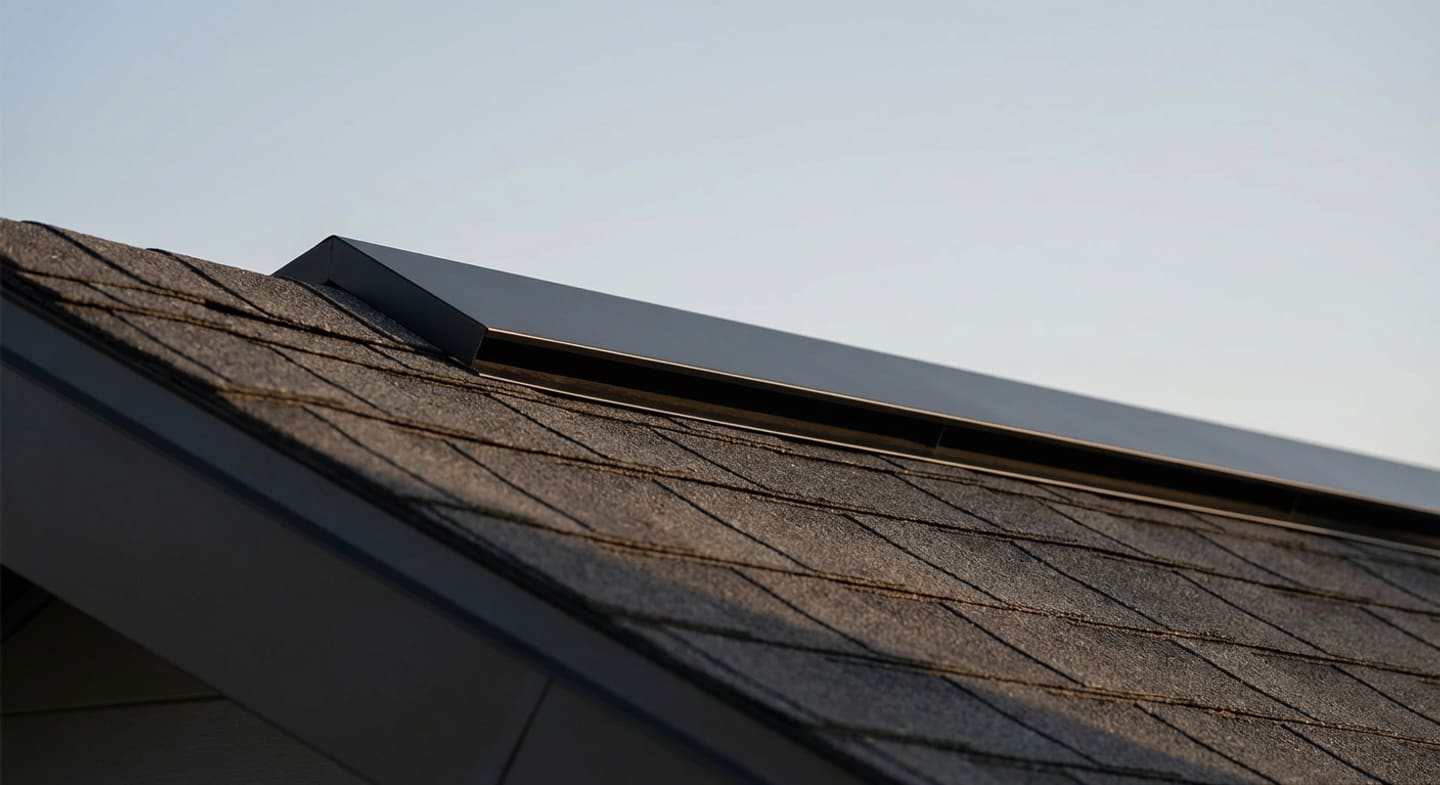
vent.png
Most bad roofs in LA are actually well-built roofs with bad attic ventilation. Here is how to tell if yours is one of them — and what to do about it.
When homeowners call us about a 12-year-old asphalt roof that's already failing, ventilation is the cause 60–70% of the time. The roof above the attic is fine. The problem is below it. An under-ventilated attic in Los Angeles routinely hits 150–170°F on summer afternoons. That temperature cooks asphalt shingles from underneath, softens the asphalt binder, accelerates granule loss, and voids most manufacturer warranties. The warranty fine print explicitly requires adequate attic ventilation; carriers check.
It's not just summer. In winter, moisture from the house (showers, cooking, breathing) rises into the attic. Without airflow, it condenses on the underside of the deck, rots sheathing, and drops back down through cracks in the ceiling paint as mystery "leaks" that don't correlate with rain events.
The building code standard is 1 square foot of net free ventilation area per 150 square feet of attic floor, split roughly evenly between intake (low, at the eaves) and exhaust (high, at the ridge). Better-designed roofs use the 1:300 ratio with a continuous ridge vent plus continuous soffit intake.
For a typical 1,500 sq ft LA home with a flat attic, that's about 10 sq ft of total vent area — 5 at the eaves, 5 at the ridge. Most LA homes built before 1990 have a fraction of that.
Blocked soffit vents. The single most common issue in LA. Homeowners added attic insulation over the decades; nobody installed baffles. The insulation covers every intake vent. Attic "has vents" but no air enters. We fix this with rafter baffles — a $200 retrofit per attic.
No intake vents at all. Common in LA homes with closed eaves, flat Spanish-style facades, or older Craftsman detailing. Even with a working ridge vent, no intake = no circulation. Requires retrofit gable vents, dormer vents, or low-profile edge vents.
"Can vents" everywhere, ridge sealed. Older LA roofs installed four or five mushroom can vents across the field instead of a continuous ridge. Better than nothing, but code-minimum at best and often below spec. Whole-roof replacement is the chance to upgrade to continuous ridge.
Wind-driven roof turbines (whirlybirds) that no longer spin. Bearings seize after 10–15 years in LA's UV environment. Dead turbines are worse than no vents — they block what opening exists.
Hidden vents under re-roofs. We routinely find existing ridge vents sealed over by a previous lazy re-roof crew. Opening them back up is free during the next re-roof.
Continuous ridge vent + continuous soffit intake. The gold standard. Silent, passive, no moving parts, no power. Install at the next re-roof — adding mid-roof is possible but expensive.
Rafter baffles + existing soffit vents. Fixes the blocked-intake problem without touching the roof. Usually a same-day retrofit.
Solar-powered attic fans. Useful supplement in extreme cases (west-facing rooflines, dark roof colors, hot climates). Not a substitute for passive ventilation. We spec them only when math says they'll help.
Gable vents with motorized louvers. Good for older LA homes without soffit access. Pairs well with continuous ridge.
If your home is in a Very High Fire Hazard Severity Zone (VHFHSZ) — Topanga, Malibu, Pacific Palisades, parts of Brentwood, Bel Air, Hollywood Hills, and many canyon communities — your attic vents must be ember-resistant. That means 1/8-inch mesh (not standard 1/4"), approved ember-resistant vent products, or baffled vents that prevent ember entry.
Standard vents in a VHFHSZ home fail fire code and void fire insurance. Check your local Building Department before any ventilation work.
Rafter baffles and soffit-vent restoration are an afternoon's work for a two-person crew. Gable vent retrofits are a half-day each. Continuous ridge vent during a re-roof is a modest upcharge on top of the roof material. Solar attic fans vary widely. Every project starts with an actual inspection — call (424) 549-7550 for a quote.
Your roof is an engineering system. The attic below it is half of the system, and usually the half that's broken.