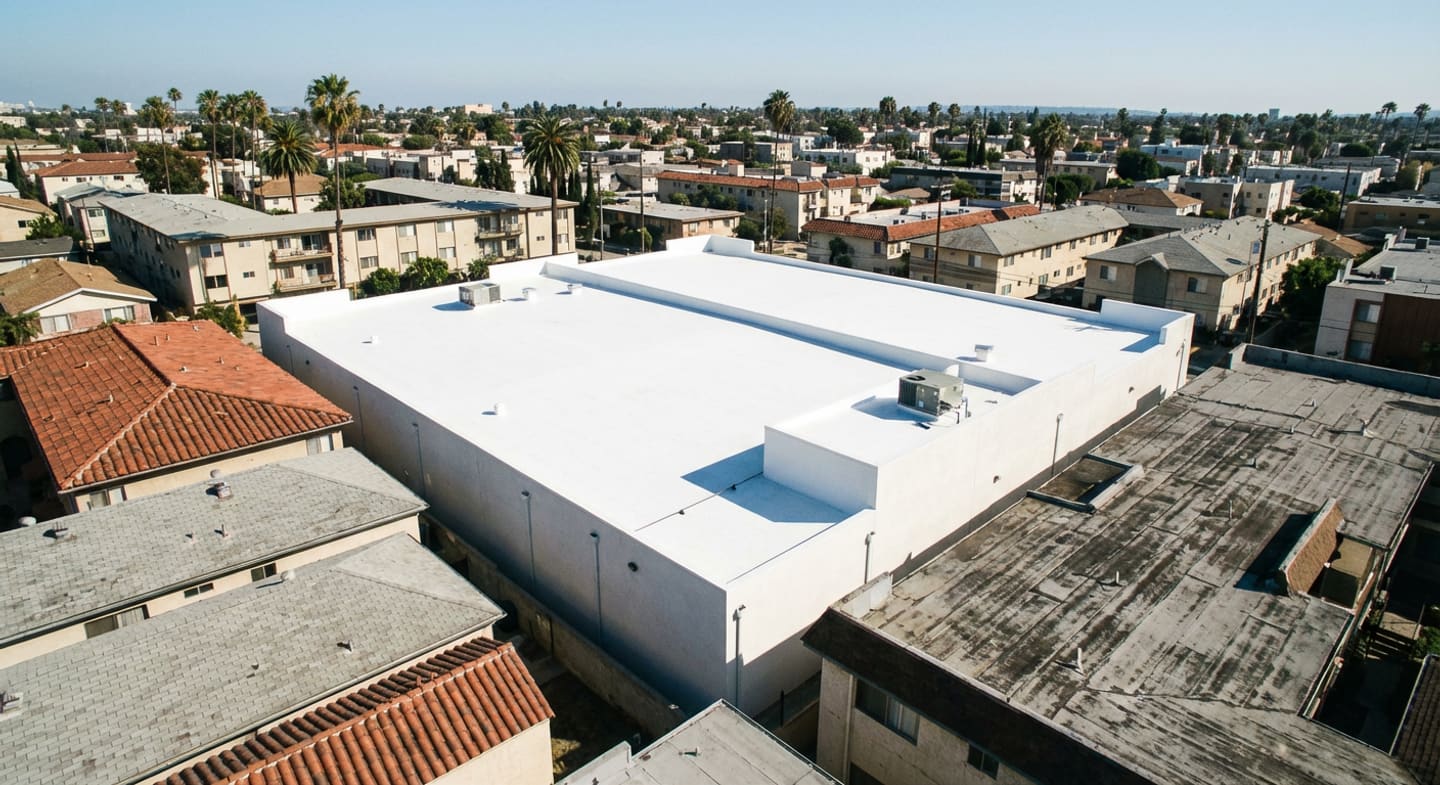
cool-roof.png
The LA Cool Roof rebate knocks real dollars off the cost of a new reflective roof, and every flat- or low-slope re-roof in California has to comply with Title 24 anyway. Here is exactly how it works — and whether it's actually worth it for your LA home.
A cool roof reflects more sunlight and emits more absorbed heat than a standard roof. The physics is measured in two numbers: Solar Reflectance (SR) — what fraction of sunlight bounces off — and Thermal Emittance (TE) — how efficiently the roof re-radiates the heat it did absorb. Combined, they produce the Solar Reflectance Index (SRI), a single number rating.
For LA's climate — 280+ sunny days, high radiant load — a cool roof can keep attic temperatures 20–40°F lower during summer afternoons. The direct effect: reduced cooling load, lower energy bills, and in many cases, extended roof material life.
California's Title 24, Part 6 energy code requires cool-roof performance on most low-slope and flat re-roof and new-construction projects in most LA climate zones. Since 2022, this extends in some forms to steep-slope residential roofs in prescriptive compliance. In plain language: if you're re-roofing a flat or low-slope roof in LA, your contractor is required by code to meet Title 24 cool-roof performance thresholds — unless you go through performance-based compliance.
We handle all Title 24 documentation on every install we do. You shouldn't have to think about it.
The Los Angeles Department of Water and Power (LADWP) offers per-square-foot rebates for qualifying cool roofs on residential properties within LADWP's service area. The rebate amount depends on product rating (CRRC-certified), roof square footage, and scope of work. Multi-family and commercial projects have separate, often higher, per-square-foot rebate structures.
Other LA-area utilities (SoCal Edison, Pasadena Water and Power, Glendale Water and Power, Burbank Water and Power) offer similar programs with different rules. Check your specific utility.
Important: rebate amounts, qualifying products, and application processes change. Always confirm current terms directly with your utility or with us before planning the work. We track the current program details so you don't have to.
Products must be rated by the Cool Roof Rating Council (CRRC) — the national testing body. The product's SR, TE, and SRI numbers must exceed the thresholds set by Title 24 and the specific rebate program.
Typical qualifying materials for LA residential:
The Valley. Summer highs routinely hit 105°F+ in Van Nuys, Reseda, Chatsworth. Cool roofs here produce the largest HVAC savings and have the fastest payback. If any LA area is a slam-dunk for cool roofing, it's the Valley.
East and South LA. Similar high-heat exposure to the Valley, often with less tree cover and more asphalt surface. Highest energy-cost burden per household, so percentage savings matter most here.
Westside coastal. Santa Monica, Venice, Mar Vista, Marina del Rey. Cooler marine layer reduces absolute savings, but Title 24 compliance still applies to flat roofs. Rebate still usually worth the paperwork.
Canyon and hillside. Topanga, Mandeville, Bel Air. Microclimate varies wildly — a south-facing Topanga hillside bakes harder than a Beverly Hills flat. Worth calculating case by case.
Cool roofs cut cooling loads. In LA's mild climate, this is a net win. In colder climates, they also cut solar heat gain in winter, which increases heating loads — not really a factor in most of LA. However: a cool roof does not fix attic ventilation, and without adequate ventilation, the roof deck still bakes and the shingles above still fail early. See our ventilation guide — cool roof + proper ventilation is the real combo.
For every install we do:
A cool roof isn't a luxury in LA — it's the default that Title 24 already chose for you. The rebate is the utility's way of helping you pay for it.