storm-prep.png
Five things every Los Angeles homeowner should do before the first real rain. One is free. Most people miss it.
LA's rainy season is short but concentrated — historically November through March, with January and February doing the heaviest lifting. In the last five years that pattern has shifted. Atmospheric-river events now routinely dump 3–6 inches of rain in 24 hours, and "light" storms of 1–2 inches are common. Roofs that leaked fine through a decade of normal weather are failing in the new pattern. The good news: most failures are preventable with a few hours of work before October.
Here is the exact checklist we give our maintenance-plan customers every September.
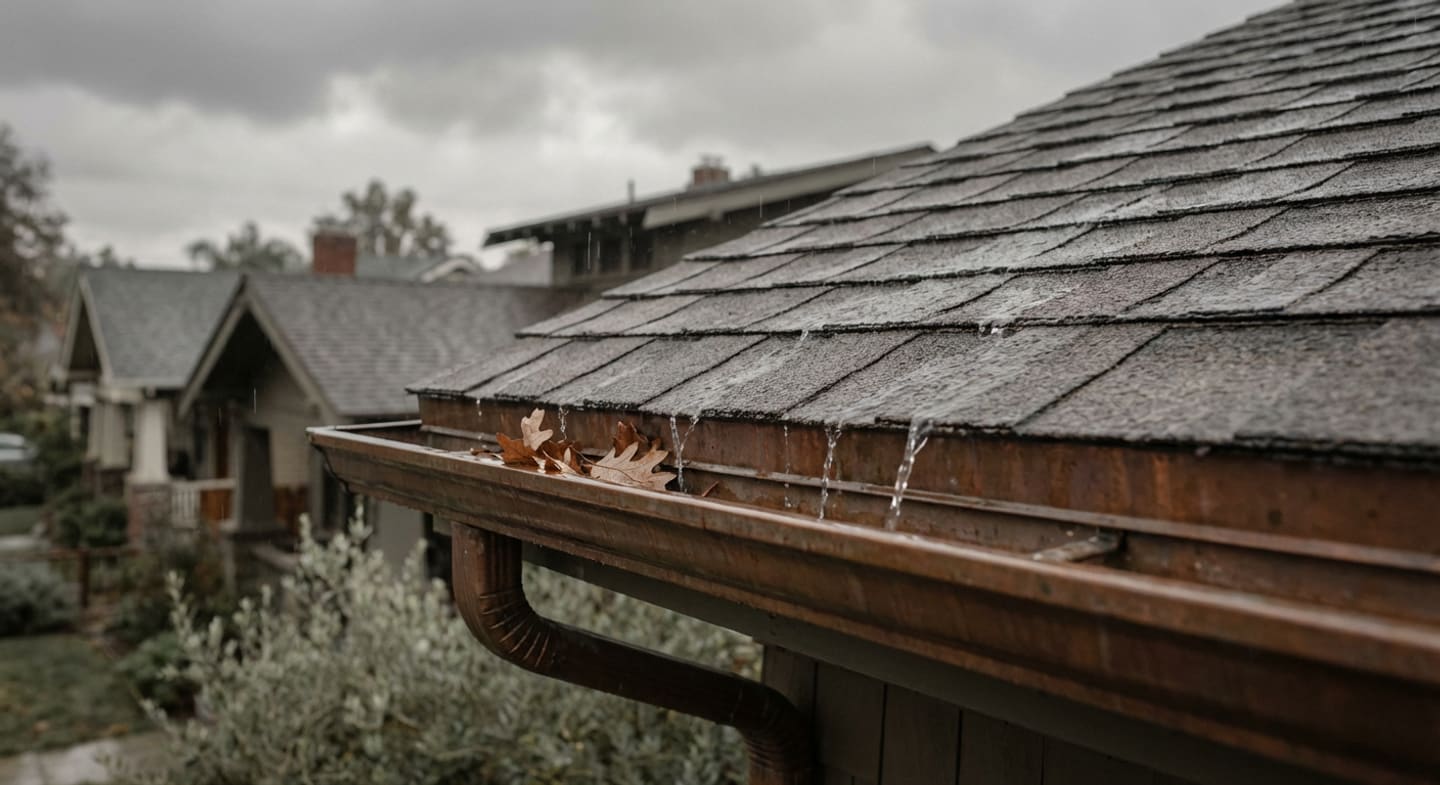
Palm fronds, eucalyptus strips, jacaranda flowers, pine needles — LA's signature landscaping is also its worst roof pollutant. Organic debris traps moisture against shingles and tiles, accelerating granule loss on asphalt and promoting moss and lichen on cement tile. Worse, it blocks valleys and scuppers, which turns a 2-inch rain event into a 2-inch pond on your roof.
If you can safely access a single-story roof, a leaf blower on low setting clears 80% of surface debris. Do not walk on wet tile or wet shingle. Anything multi-story, steep-slope, or under tree cover should be handled by a crew with harness gear — call (424) 549-7550 if you are unsure.
This is the free one most homeowners miss. A gutter full of last year's debris overflows during the first storm, sheets water behind the fascia, and rots the deck within a single season. We diagnose "roof leaks" every winter that turn out to be entirely gutter-driven.
After clearing, run a garden hose into each gutter section at full pressure for two minutes. Water should exit the downspout in a steady stream within ten seconds. Slow flow means a downspout clog — clear it with an auger or remove and rinse. No flow at all means the gutter slope is wrong or the downspout is blocked; that's a repair, not a DIY. See our gutter service page.
Flashing is the #1 cause of leaks in Southern California, full stop. Every vent stack, skylight, chimney, valley, and HVAC curb has metal flashing underneath that was installed sometime between when the roof was new and, well, now. Sealant hardens, cracks, and separates from flashing over 10–15 years. In LA's UV-heavy sun, the degradation curve is steeper.
Walk around the roof edge (binoculars work fine) and look at every penetration. Cracked sealant, visible daylight at flashing joints, pulled fasteners — all warn of imminent failure. A tube of quality polyurethane sealant (not silicone) from a hardware store addresses small issues; bigger ones need flashing replacement. See roof repair.
Go into the attic with a flashlight on a sunny day. Turn off the flashlight. Look around. Any spot of daylight you see from below is a water path from above. It is as simple as that. Mark the location with blue tape and call us.
While you are up there, confirm that ridge vents, soffit vents, or gable vents are actually open (not blocked by insulation) and that you can feel air movement on a warm day. An attic that does not breathe traps moisture during storms — and moisture rots decking from underneath, which you will not see until it fails dramatically. See our LA ventilation guide.
If storm damage happens later, your insurance adjuster will ask when it happened and what condition the roof was in before. "Before" photos dated September or October close that argument instantly.
Take photos from all four sides of the house (if safely accessible from the ground or via drone), every visible roof plane, every penetration, and every gutter run. Email them to yourself so the timestamp is preserved on a server you do not control. Do the same for the interior ceilings of any room that has caused trouble before.
Insurance carriers increasingly deny claims on roofs that cannot be shown to have been in good condition pre-loss. Ten minutes of photography in September protects thousands of dollars of potential claim payouts. See our insurance-claim guide.
Anything the above checklist uncovers is almost certainly a symptom of a deeper issue. A professional inspection catches issues the homeowner cannot see — nail pops, underlayment degradation, membrane seam failures on flat roofs, deck sheathing moisture. Our inspections include a written report, photo evidence, and a prioritized action list. See roof inspections.
For maintenance-plan customers, the pre-season inspection is included. See our maintenance plans.
The best roof is the one you think about twice a year, not twice a week.
Call (424) 549-7550 — we have 24/7 emergency tarp crews across LA County, typically on site within 90 minutes. Do not wait for the storm to end; interior damage multiplies by the hour.